鲨鱼
Unitree Robotics IPO sparks investor frenzy as policy support fuels capital rush, with sector’s future value tied to continued commercialization_我的网站

一 |
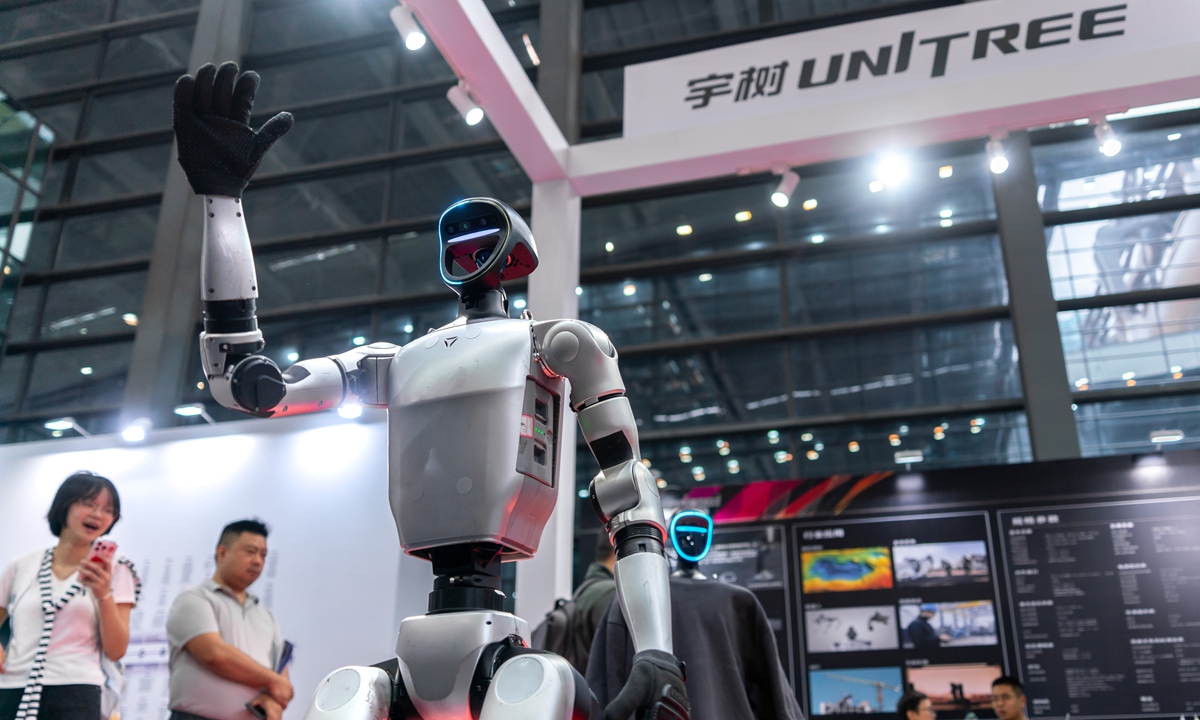
Unitree Robotics' humanoid robot is displayed at the 14th China Information Technology Expo in Shenzhen, South China's Guangdong Province, on April 10, 2026. Photo: VCG
With just one day to go before Chinese humanoid robotics pioneer Unitree Robotics opens subscriptions for its initial public offering (IPO) on Shanghai's STAR Market, investor attention has extended far beyond the company itself, highlighting a broader capital-market rush into embodied intelligence as the sector moves from technological breakthroughs toward commercialization.
As of press time, discussions surrounding the IPO have pushed the topic to the top of trending lists across multiple stock trading platforms. The debate has focused on Unitree Robotics' disclosed short-term financial performance, as well as the potential opportunities for investors from China's policy push to include embodied intelligence and humanoid robots among key areas of medium- and long-term technology and industrial development.
Experts said the wave of IPOs among robotics companies, including Unitree Robotics, represents a shift that allows robot makers to engage more directly with public markets and investors. It also brings companies at different stages of development and pursuing different technological paths into a common valuation framework, promoting market comparisons and competition.
At the same time, the capital-market boom is likely to accelerate a shakeout, separating companies capable of building sustainable business models from those that struggle to turn technological advances into commercial returns.
On Thursday, Unitree Robotics released its announcement on the IPO of shares and listing on the STAR Market. According to the announcement, the offering price was set at 150.80 yuan per share, valuing the company at approximately 61 billion yuan ($9.04 billion) upon listing.
Secondary-market professionals told the Global Times that demand for Unitree Robotics' IPO subscription could be extremely high, meaning the chances of individual investors securing shares are likely to be very limited.
Robotics is currently one of the few categories that can translate AI capabilities into tangible assets with relatively comparable valuation metrics, creating a unique advantage in valuation narratives. This scarcity is one of the key factors drawing the attention of both large and small investors, Tian Feng, former dean of SenseTime's Intelligence Industry Research Institute, told the Global Times on Sunday.
Unlike large language model companies, whose capabilities are often assessed through benchmarks and demonstrations that are difficult for ordinary secondary-market investors to directly evaluate, robots offer visible and verifiable evidence through tasks such as grasping, walking and dexterous manipulation, Tian said. This tangible demonstration of "embodied" intelligence naturally creates a valuation premium in market narratives, he added.
Tian cautioned that extreme subscription figures, such as RobotHoenix's 14,855-fold oversubscription on its listing and LDRobot's 127.62 percent first-day share price surge, were driven by a combination of institutional advantages and sector scarcity rather than serving as evidence of the commercial validation of robotics products. He noted that there is no direct correlation between oversubscription multiples and the certainty of product deliveries or commercialization prospects.
Beyond Unitree Robotics, a broader financing boom in China's robotics industry has also gained significant momentum, with the Hong Kong Stock Exchange emerging as the main battleground for this latest IPO wave.
Citing industry data provider Wind, the China STAR Market reported that five robotics-related companies have gone public in Hong Kong so far in 2026. Meanwhile, 51 companies with businesses spanning industrial robots, service robots and embodied intelligence solutions are currently in the IPO pipeline in Hong Kong, accounting for 12.7 percent of all companies awaiting listing.
According to data from IT industry research platform ITjuzi.com, financing in China's embodied intelligence sector totaled 93.5 billion yuan in the first half of 2026, surpassing 90 billion yuan and marking a fivefold increase from the same period in 2025. The number of financing deals reached 322, up 137 percent year-on-year.
Tian said that while policy support and clearer commercialization pathways are boosting confidence in the sector, the latest IPO wave should also be viewed through a more cautious lens. The surge comes partly as the primary market's ability to continue funding embodied intelligence companies faces limits, prompting firms to seek new liquidity channels through public markets, rather than solely reflecting a dramatic leap in industrial maturity.
As emerging technology sectors increasingly become the focus of public attention, more objective and professional analysis is also needed to help investors assess companies' technological capabilities, commercialization prospects and long-term value, rather than simply following market enthusiasm, Chinese experts noted.
。
Xi hopes quake-hit nation can rebuild itself at early date President Xi Jinping sent a message of condolence on Tuesday to Colombian President Abelardo de la Espriella after a magnitude 7.4 earthquake rocked the South American nation on Monday, killing more than 200 people and injuring over 600. In his message, Xi said he was deeply shocked to learn that a powerful earthquake had caused heavy casualties and significant property loss in Colombia. On behalf of the Chinese government and people, he expressed deep condolences over the deaths and extended sincere sympathies to the bereaved families and the injured. Xi also expressed confidence that under the leadership of the Colombian government led by de la Espriella, the Colombian people will make concerted efforts to overcome the disaster and rebuild their homes at an early date. Meanwhile, the China International Development Cooperation Agency, which coordinates foreign aid missions, announced that the nation stands ready to provide assistance within its capabilities to support quake relief efforts in Colombia. China is closely following the developments and will provide assistance in an appropriate manner based on Colombia's needs, agency spokeswoman Tang Ying said in an online statement on Tuesday. Rescue efforts across western Colombia continued for a second day as emergency workers dug through the rubble of collapsed buildings in several cities and towns, including Pereira and Cali, amid grim expectations that the death toll from the country's most powerful earthquake in decades could rise. According to the Colombian Geological Service, the quake hit at 7:34 am on Monday at a depth of 96 kilometers, with its epicenter identified near San Jose del Palmar in the department of Choco, about 400 km from Colombia's capital Bogota. As much of Choco is accessible only by boat, through the jungle or by airplane, little was known about the extent of damage there. De la Espriella, who has declared a state of national emergency, traveled to Choco's capital, Quibdo, on Monday night to assess the damage and announced that he had mobilized "the entire military and police apparatus" for relief and rescue operations. Earlier in the day, he told reporters: "Our intention is to cooperate in any way necessary. Here, there are no distinctions or ideological divisions when it comes to defending our people or showing solidarity." According to local media reports, 32 cities in the western region have been severely affected, while five departmental capitals — Pereira, Cali, Quibdo, Manizales and Armenia — continue to remain under red alert for aftershocks. The quake has turned dozens of multistory buildings into piles of concrete and twisted metal in cities such as Pereira, and brought down the towers of a landmark cathedral in Manizales. In Cali, a city of about 2.2 million people, at least 85 people have been confirmed dead. Several floors of a city hospital collapsed during the temblor, trapping many patients. Seven airports in western Colombia have suspended operations due to structural damage. A video posted on social media and verified by Reuters showed the Cali airport swaying violently and people scurrying for shelter amid collapsing chunks of concrete. On Monday, the Chinese embassy in Bogota activated an emergency response mechanism to assess the safety of Chinese nationals. No casualties among Chinese citizens were reported as of press time on Tuesday. The powerful earthquake was also felt in Ecuador and Venezuela, which share their borders with Colombia. In June, two back-to-back temblors in Venezuela had killed more than 6,300 people.


。

二 |
Current article:http://djeyb.nenyaogecebenliexi.shop/hx9jnko/20260826/4450.html
Published on:13:13:15


 。
。


